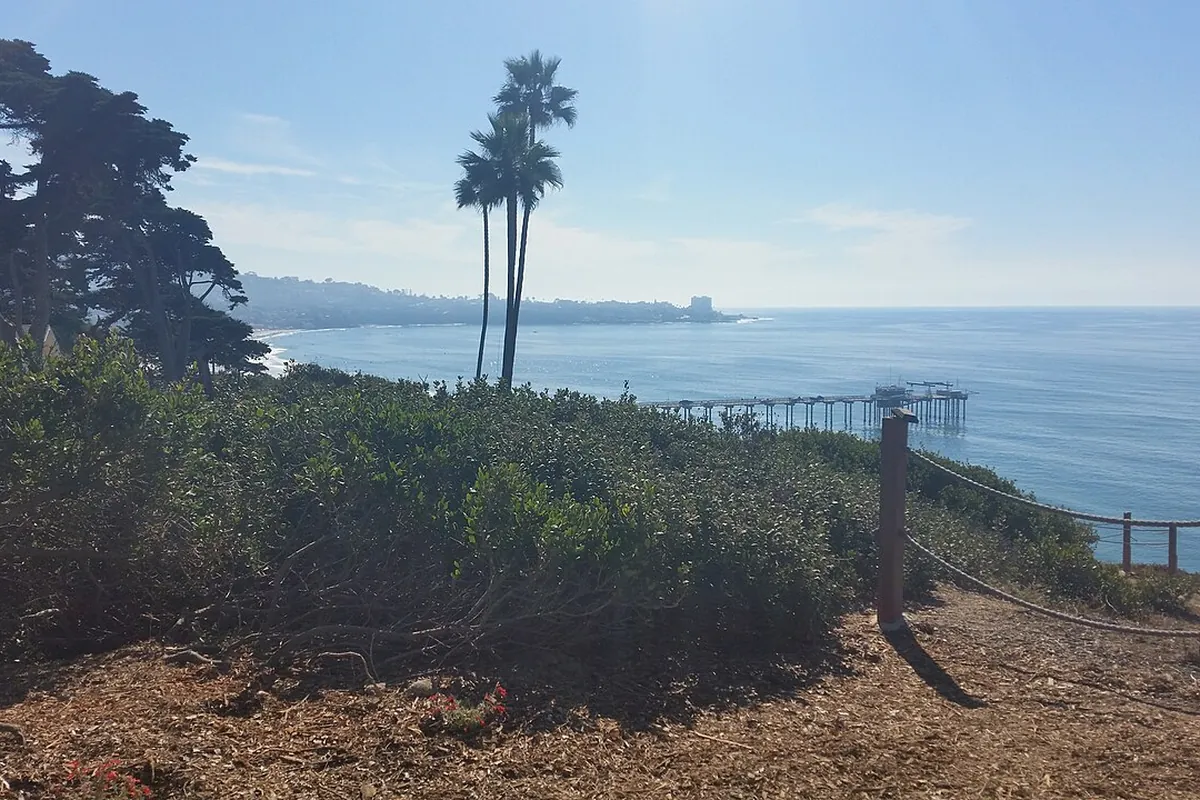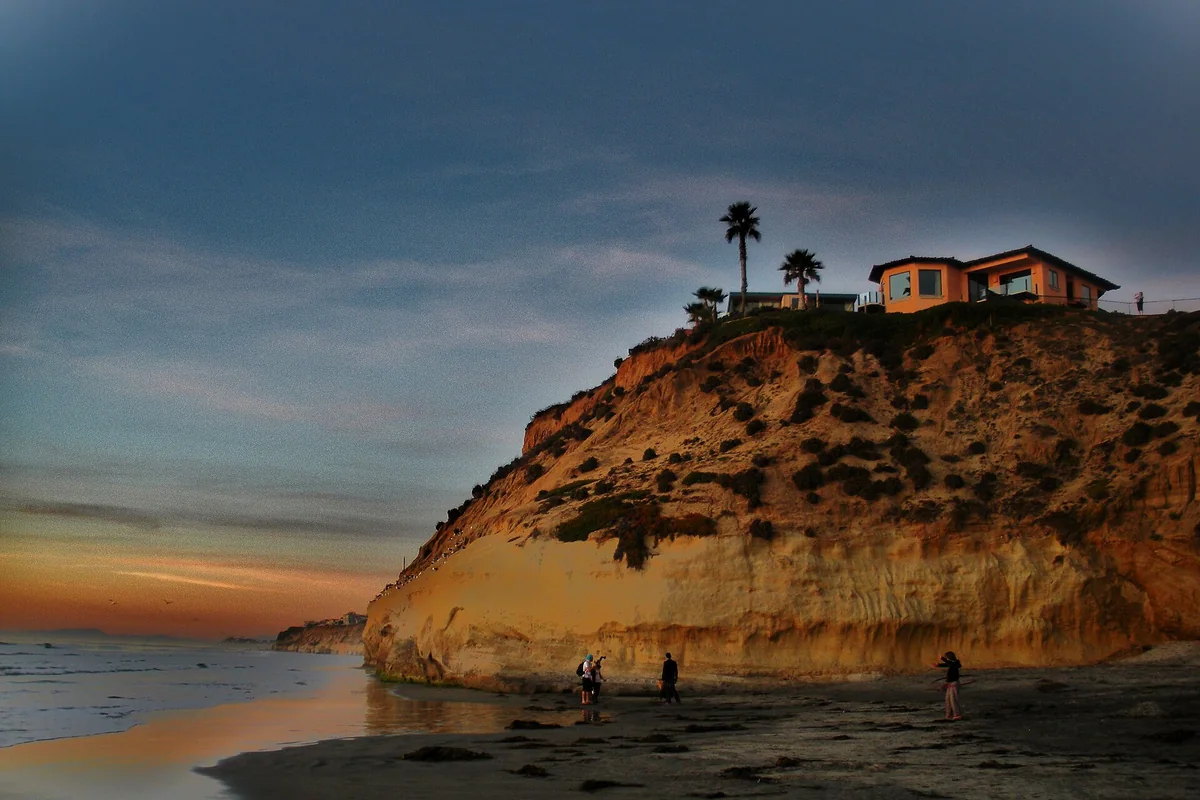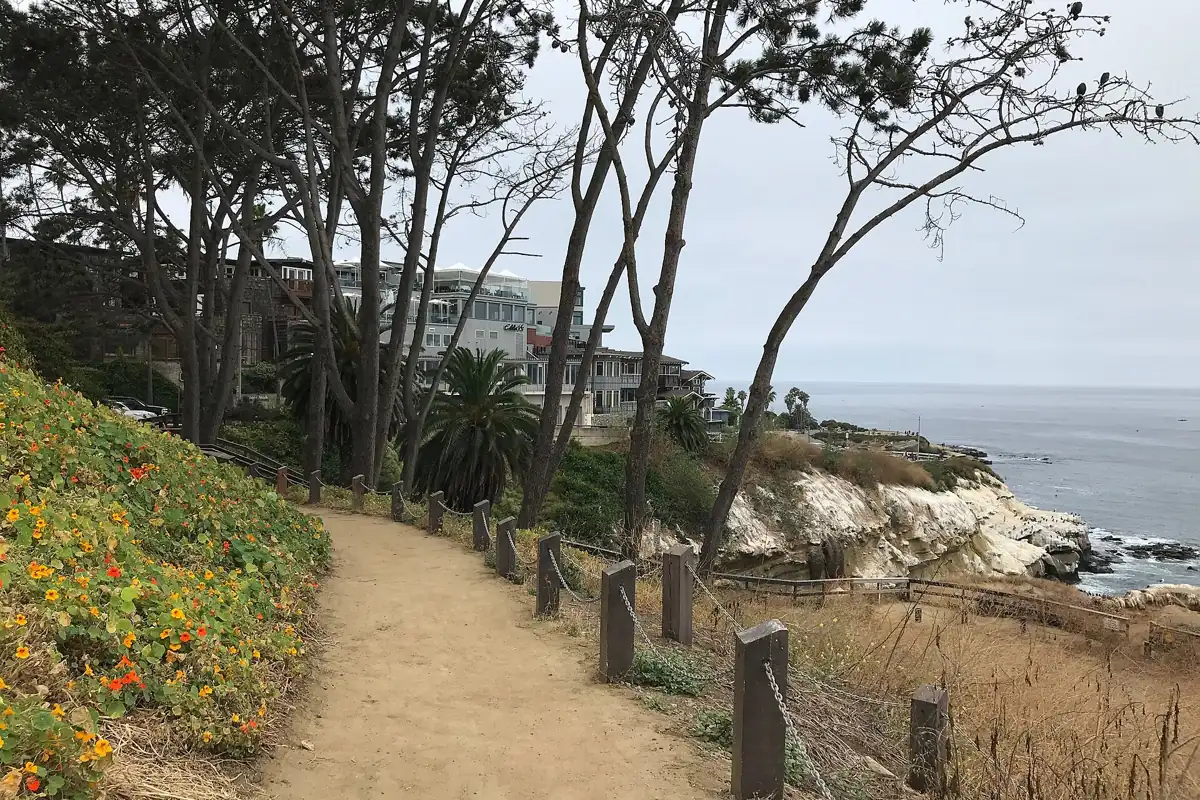
The Coast Walk Trail is a short La Jolla walking trail above the ocean cliffs, connecting the Cave Store and Goldfish Point area with Coast Walk near Torrey Pines Road. It is a scenic bluff-top path, not a route down to the sand. Friends of Coast Walk Trail, the nonprofit that helps care for it, describes the route as 0.6 mile. Give this little coastal walk more attention than its distance might suggest: uneven footing, narrow sections and exposed bluff edges make it different from an ordinary seaside sidewalk.
Choose it when you want to watch the water, study the coastline and add an unhurried walk to time in the village. Choose a different outing when your priority is a wide, step-free promenade or an easy place to push a stroller. The best version of this walk is slow, in daylight, with room to stop without blocking other people.
Where the La Jolla Coast Walk begins and ends
The trail sits along the bluffs just north of central La Jolla. The maintenance group's project descriptions identify a route from the corner of Torrey Pines Road and Coast Walk toward the Cave Store and Goldfish Point. Those landmarks are more useful than searching for a generic “La Jolla trail,” which can send you to entirely different parts of the coast.
You can approach from either end. From the village side, look for the public trail near the Cave Store area, rather than assuming you need to enter the store. From Torrey Pines Road, use Coast Walk to find the signed public approach. Respect the distinction between public access and private residential driveways: an ocean-facing gap is not automatically a trailhead.
Before setting out, look at the maintenance group's trail project information and any notices at the entrance. Repairs to barriers, drainage, slopes and the walking bridge matter on this route. If a section is closed, do not try to get around it along the bluff or through neighboring property.
How long is the Coast Walk Trail?
Friends of Coast Walk Trail lists a 0.6-mile trail. Do not confuse that description with the mileage on a fitness app that includes your parking walk, a loop through the village or a detour to the Cove. Your total outing depends on where you start and whether you retrace your steps.
For a simple visit, walk only as far as your group feels comfortable, then turn around. A short out-and-back lets you see the same coast in different light without arranging transport. If you return through streets instead, check the walking route before leaving the trail, and use proper crossings near Torrey Pines Road. A line on a phone map does not establish safe pedestrian access.
What to expect on the La Jolla coastal trail
This is a coastal cliff walk with changing views rather than a hike built around one summit. Look along the headlands, across open water and down toward the rocky shore from established places on the path. The landscape is the attraction: bluff faces, coastal vegetation, moving water and the way the shore curves toward the village.
Expect a mix of trail surfaces and built features, not a continuous flat sidewalk. The maintenance organization documents slope stabilization, resurfacing, barrier repairs, benches and bridge work. That is a useful reminder to watch where you put your feet even when the view is distracting. Let faster walkers pass at a wide spot, and keep bags close enough that they do not catch on railings or other people.
Wildlife sightings are a possibility, not an itinerary promise. If you see birds or marine mammals below, use binoculars or your camera's zoom. Do not climb off the path for a clearer photograph. You can enjoy a coastal animal sighting without getting close enough to change its behavior.
Coast Walk Vista Point and places to pause
Searches for “Coast Walk Vista Point” often refer to the overlooks associated with this same bluff-top outing. Treat a vista point as a place to pause within the public access area, not as permission to step beyond a barrier. Ocean views do not require standing on the outer lip of the bluff.
The trail group's projects include work at an overlook near 1555 Coast Walk and at Goldfish Point. It also describes bench repairs along the route. Use a bench or a broad section for a longer stop, especially if you are taking photographs or helping children spot something offshore. Avoid gathering where people need to negotiate a narrow passage.
Parking for the La Jolla beach trail area
Plan around legal street parking or a public parking facility in the village, then walk to the entrance. Read the actual signs for limits, restrictions and payment requirements. Small residential approaches are a poor place to count on finding a convenient space, and a trail landmark should not be mistaken for a dedicated parking lot.
Do not wait in a travel lane, park across driveways or use a private space because the trail looks quiet. A sensible approach is to decide on parking before your group arrives, save the walking route and leave extra time for the return. If the nearest streets are full, increase the walk rather than improvising a parking place.
This guide does not quote a parking price, guarantee a space or promise nearby public restrooms. Those details depend on the facility you choose and can change independently of the trail. For a group with specific restroom or mobility needs, establish those arrangements before starting.
Cliff safety, children and walking conditions
Keep everyone on the designated path and inside the barriers. Bluff edges can fail without an obvious warning. The ground immediately behind an edge is not necessarily secure simply because it looks dry or has footprints on it. Do not sit on barriers or use a fence as support for a pose.
Wear shoes with traction, carry water and use sun protection. On a narrow trail, supervising a child means staying close enough to guide them through crossings and exposed spots, not just keeping them in sight. If the group includes someone who needs a uniformly firm, wide surface, reconsider the route rather than assuming the short distance makes it accessible.
After rain or during maintenance, conditions can change. Obey closures even if an older review says the route is easy. Turn around if the footing, crowding or exposure feels wrong for your group. You do not need to finish the entire route to have a worthwhile La Jolla coast walk.
Is this the Salk Institute beach trail?
No. The Salk Institute is in the Torrey Pines mesa area, well north of this village-side Coast Walk. Searches for “Salk Institute beach trail” describe a different location and should not be used as directions to this route. Likewise, trails associated with Black's Beach are not extensions of Coast Walk.
If your goal is a beach visit, select a signed, established beach access route and check its current condition separately. Coast Walk is best understood as a bluff-top walk. There is no need to look for an unofficial descent from it, and following someone down a slope does not make that slope a safe public route.
A practical plan for the visit
- Choose the village or Coast Walk approach, and save that entrance on your map.
- Check trail notices and arrange legal parking without relying on a tiny residential street.
- Walk in daylight, keeping phones away while negotiating narrow or uneven sections.
- Pause at established overlooks, then retrace your route or return by a checked street connection.
- Add another coastal stop only if your group still has time and energy.
For a longer day, compare the La Jolla ecological reserve guide with the broader San Diego beaches guide. The former helps explain the protected water below the village; the latter helps you choose an actual beach. Both are better next steps than trying to turn a cliff walk into an improvised scramble.
Questions before you go
Does Coast Walk Trail lead down to the beach?
It is a bluff-top route. Do not use unofficial cliff descents; choose a separate established beach access.
Is Coast Walk Trail the same as a trail near the Salk Institute?
No. The village-side Coast Walk and the Salk Institute area are separate locations.
Sources & further reading
Official information and references for this guide. Check the source for current access, rules and conditions.